Language Learning - Music
How music can support language learning through repetition, lyrics, listening and singing

Music Is the Easiest Input to Come Back To
There are days when I genuinely want to study.
I can listen to a podcast, read something difficult, make flashcards or have a lesson with a tutor.
And then there are days when my brain wants absolutely none of that.
Music survives those days.
If I go for a long walk and feel motivated, I might listen to a Russian podcast. If I don’t have the energy for that, I can put on Russian music instead.
The walk still takes the same amount of time and I’m still hearing Russian. I’m just not forcing myself to concentrate on every sentence.
I don’t think every minute with a language needs to be highly efficient study.
Sometimes the most useful thing is simply keeping the language present.
And music makes that incredibly easy, because if I like a song, I’ll probably listen to it again tomorrow anyway.
At First, a Song Is Just Noise
One of the strangest things about learning a language is how much your perception changes.
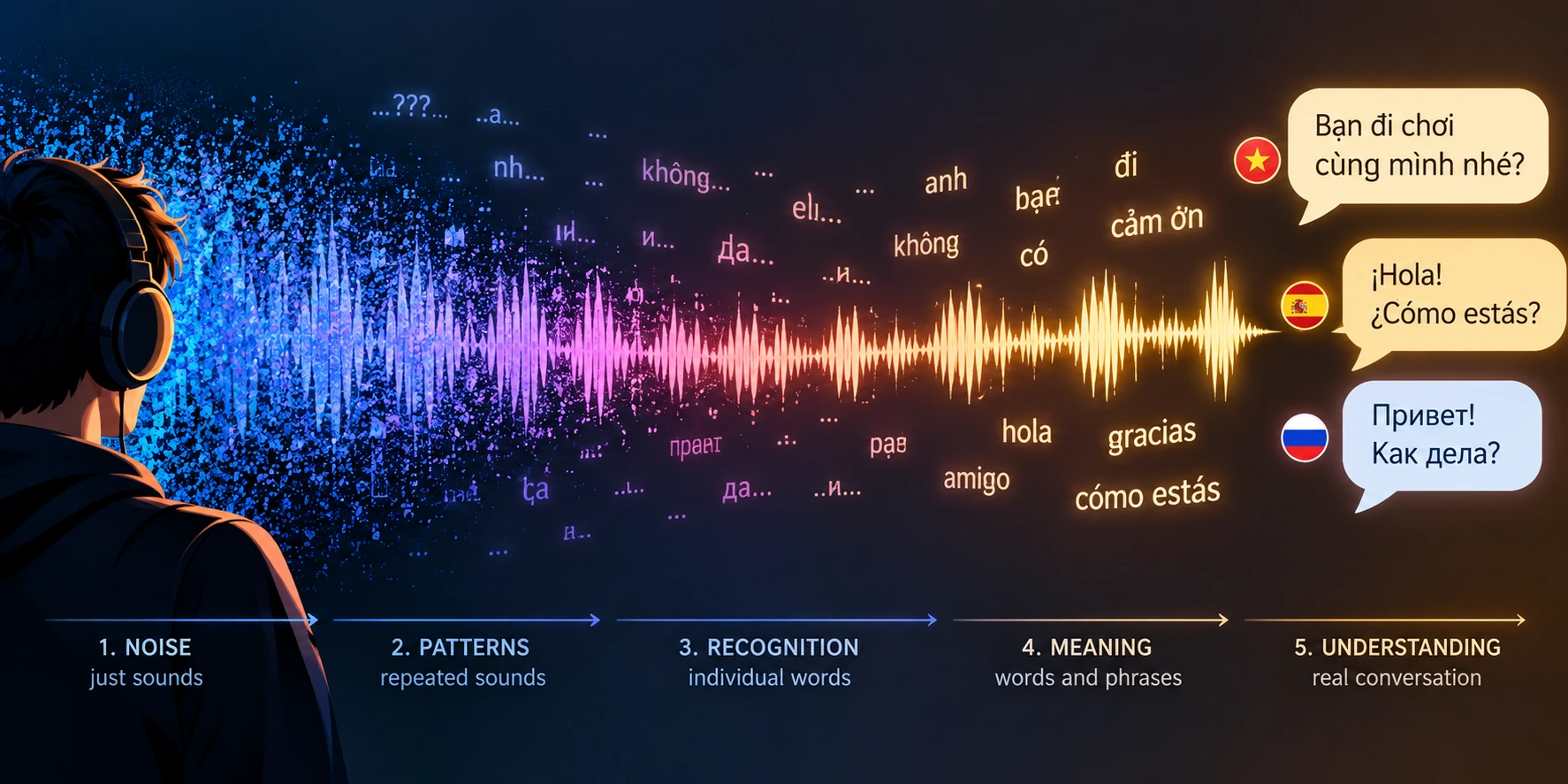
At first, a song can sound almost completely incomprehensible.
You know there are words in there. Your brain just hasn’t learned where they begin and end yet.
This is especially obvious to me with Vietnamese.
Sometimes I can read a word and understand it immediately, but when I hear the same word, my brain acts like I’ve never seen it before.
Songs make that problem even more obvious because there is melody, stretched pronunciation and rhythm on top of the language itself.
But after enough repetition, something changes.
A word appears. Then a phrase. Then an entire line suddenly becomes clear.
The song didn’t change. My brain did.
How I Practise With Lyrics
When I really like a song in one of my target languages, I don’t immediately try to memorize it.
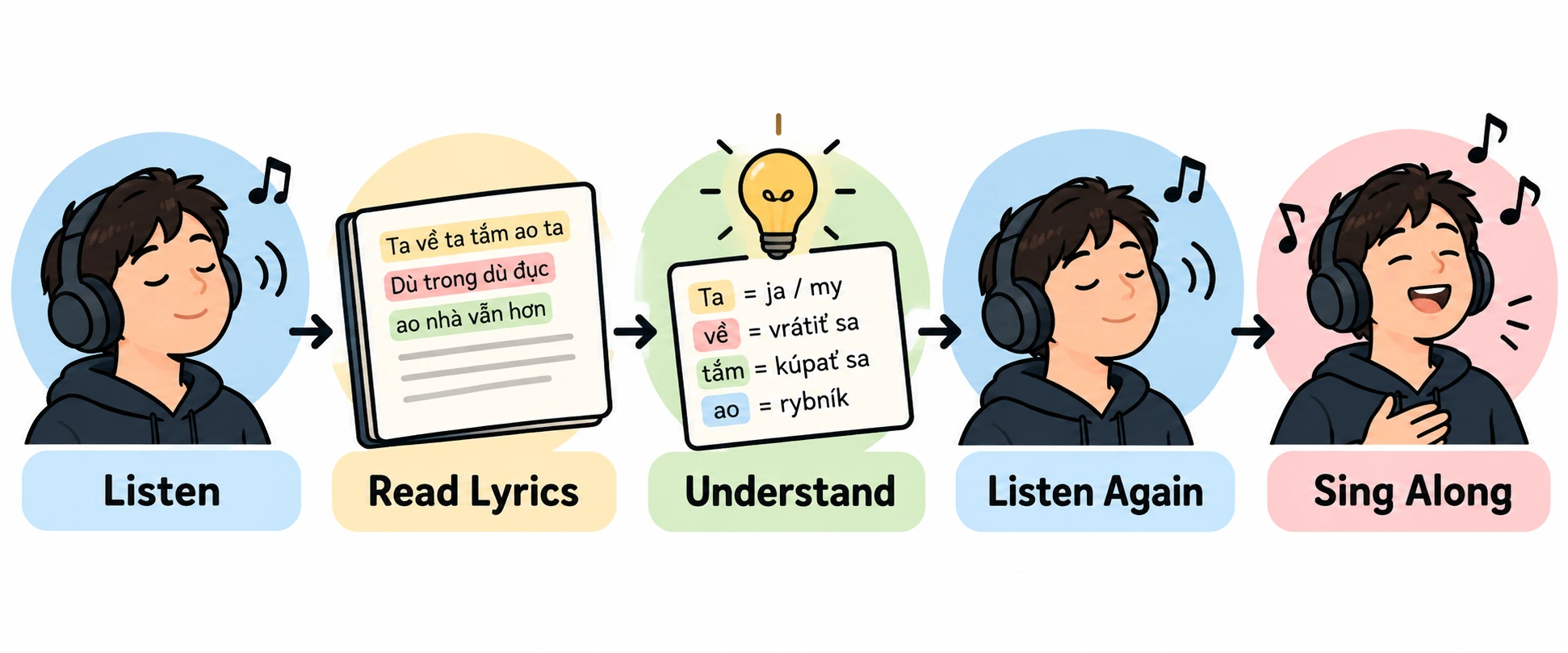
First, I listen normally and see what I can recognize on my own.
Then I open the lyrics and read through them. This is especially useful with Vietnamese because I often have the opposite problem:
I recognize the word when I see it, but I don’t recognize it when I hear it.
I check the meaning of unfamiliar phrases and make sure I actually understand what the song is saying. Then I listen again while following the lyrics.
After that, I start listening without looking at the text.
The goal is to slowly connect:
written word -> sound -> meaning
Eventually, if I really like the song, I start singing along and naturally memorize large parts of it.
At that point, I’m no longer trying to remember the lyrics. I simply hear the words.
That’s exactly what happened to me with Russian songs such as Камин and now I’m trying to recreate the same process with Vietnamese.
Singing Along Is More Useful Than It Looks
At some point, I usually stop just listening and start singing along.
At first, badly.
Sometimes very badly.
But this actually adds another layer to the process.
Listening helps me recognize the language. Singing forces me to reproduce it.
I have to follow the rhythm, remember the words and produce the sounds quickly enough to keep up.
And because it’s a song I actually like, repeating the same line twenty times doesn’t feel annoying.
If a textbook asked me to repeat the same sentence twenty times, I would probably hate it.
With music, I often do exactly that without even thinking about it.
Over time, the pronunciation, rhythm and phrasing start to feel much more natural.
Russian Showed Me That This Actually Works
Russian is probably the language where I first noticed how useful music could become without me planning it.
At first, I was simply listening to songs I liked.
Then certain words started becoming familiar.
Then whole phrases.
And eventually I could sing parts of songs without consciously trying to memorize them.
That was the moment I realized music was doing more than just sitting in the background.
It was reinforcing vocabulary, pronunciation and listening at the same time.
I still needed podcasts, games, lessons and real conversations to improve my Russian.
Music never replaced any of that.
It simply gave the language another place to live in my daily life.
Vietnamese Is a Completely Different Challenge
Vietnamese shows me the opposite side of this process.
With Russian, I already understand enough for music to reinforce things I know.
With Vietnamese, a song can still feel like a decoding exercise.
I might know the words when I see them, but completely miss them when I hear them.
That is one reason songs are useful for me right now.
If I already like the song, I am willing to listen to it again and again, read the lyrics, check the meaning and slowly connect the sounds with the words.
Songs like Bắc Bling are a good example.
At first, I understood almost nothing.
But every time another phrase becomes recognizable, the song feels a little less like noise.
Vietnamese music is not easy input for me yet - but that is exactly why it can be useful.
Why Repetition With Music Doesn’t Feel Like Repetition
Language learning needs repetition.
The problem is that repetition gets boring very quickly.
Reading the same paragraph twenty times would drive me crazy.
Listening to the same song twenty times feels completely normal.
Music makes repetition feel invisible.
Every listen gives me another chance to notice something new.
Maybe one word becomes clear.
Then a phrase.
Then the chorus suddenly makes sense.
Over time, the language starts feeling familiar simply because I have heard it so many times.
That kind of repetition is much easier to maintain when I actually enjoy what I’m listening to.

Music Works Differently at Different Language Levels
I don’t think music does the same job at every stage.
With Spanish, it is mostly entertainment.
I understand enough that I can simply enjoy the song and maybe pick up an expression without thinking about it.
With Russian, music still reinforces vocabulary, listening and pronunciation.
With Vietnamese, I usually need much more support from lyrics and repeated listening.
The same activity can have a completely different purpose depending on your level.
Spanish can be maintenance.
Russian can be reinforcement.
Vietnamese can be active listening practice.
The useful question isn’t whether music helps language learning, but what it can realistically do for you right now.
Knowing a Song Is Not the Same as Understanding the Language
There is one important trap with music.
You can become very good at understanding one song simply because you have heard it so many times.
You know the lyrics.
You know what comes next.
You know the melody.
That does not necessarily mean you would understand the same words in a normal conversation.
If I can sing a Vietnamese line perfectly after hearing it fifty times, that doesn’t mean I would immediately recognize those words from a stranger speaking quickly.
The song still helped me.
The sounds became more familiar and the connection between pronunciation and meaning became stronger.
But understanding a memorized song and understanding the language in the wild are two very different things.
Music Should Support Language Learning, Not Replace It
I would never recommend learning a language only through music.
Songs can be poetic, pronunciation can change to fit the melody and some vocabulary is not especially useful in normal conversation.
Music is great input, but it is not complete input.
If I want to understand real Vietnamese conversations, I still need to listen to real Vietnamese conversations.
If I want to speak Russian better, I still need to actually speak Russian.
Music works best as one piece of a bigger system.
Podcasts help with extended listening.
Tutors help with conversation.
Books help with reading and vocabulary.
Music gives me repetition, pronunciation practice and a reason to keep hearing the language.
It doesn’t need to do everything to be useful.
How Music Fits Into My Language Learning
Music is not the centre of my language learning.
But it fits into it extremely well.
I already use tutors, podcasts, books, games and flashcards for different reasons.
Music fills the gaps between them.
It is the easiest form of language exposure for the moments when I don’t feel like studying.
I can listen while walking, travelling or doing something else.
Sometimes I actively follow the lyrics.
Sometimes I sing along.
Sometimes the language is simply playing in the background.
And all of those versions still keep the language present in my life.
That is probably why music works so well for me.
It doesn’t always need its own study session.
Sometimes a Song Should Just Be a Song
I don’t want to turn every song into a lesson.
Sometimes I don’t care what every line means.
Sometimes I just like the sound.
And that is completely fine.
The moment every hobby becomes study, it starts becoming harder to enjoy the hobby.
Some songs I analyse.
Some songs I learn well enough to sing.
And some songs simply stay in my playlist.
Over time, I may still start recognizing words and phrases without deliberately trying.
Music is useful partly because it doesn’t always feel useful.
Sometimes the best thing a song can do for my language learning is simply make me want to hear that language again tomorrow.