Language Learning - Duolingo
Is Duolingo actually useful for learning languages?

Is Duolingo Actually Good?
Ask language learners about Duolingo and you will usually hear one of two opinions.
One side says:
“Just do Duolingo every day and eventually you’ll become fluent.”
The other says:
“Delete Duolingo. It’s useless. Just watch comprehensible input.”
I don’t really agree with either.
I used Duolingo for roughly a month for every single language I started learning.
I never expected it to teach me the entire language.
And I think that’s an important distinction.
Duolingo is a pretty good tool when you treat it as a tool.
The problems start when you expect one app to somehow teach you vocabulary, grammar, listening, pronunciation, spontaneous speaking, reading, writing and real-world communication all by itself.
The problem isn’t using Duolingo. The problem is expecting Duolingo to do everything.
Starting a Language Is Harder Than It Looks
People who have already learned a language sometimes forget how confusing Day 1 can be.
You want to learn a language. Great.
- Now what?
- Which textbook?
- Which YouTube channel?
- Should you learn grammar first?
- Should you memorize the most common 1,000 words?
- What exactly is comprehensible input?
- Do you need a tutor?
- Which pronunciation guide is actually correct?
You can spend more time designing the perfect learning system than actually learning anything.
Duolingo removes almost all of that friction.
Open app -> select a language -> start.
That simplicity has real value.
You’re immediately learning some basic vocabulary, seeing sentence structures and interacting with the language.
When I started Spanish, that’s basically how I treated Duolingo: an easy introduction.
Eventually I moved toward things that gave me much more exposure to actual Spanish. But Duolingo helped get the machine moving.
And sometimes getting started is the hardest part.

“Better Than Nothing” Is Underrated
Language-learning communities are obsessed with optimization.
- Which method produces the most vocabulary per hour?
- Which flashcard settings are optimal?
- How many minutes of comprehensible input?
- Should you read before listening?
All useful questions.
But there is another variable that matters:
Will you actually do it?
Imagine you have three options tonight:
A) Do 15 minutes of Duolingo.
B) Do your theoretically perfect 45-minute language routine that you keep postponing.
C) Scroll Instagram, Reddit or TikTok for an hour.
Duolingo wins.
Not because it is the world’s most efficient language-learning method.
Because you actually learned something.
An inefficient method you actually use is more effective than an optimal method you keep postponing.
I think Duolingo is especially useful on days when motivation is low.
Five or ten minutes isn’t going to transform your language ability.
But keeping contact with the language matters.
And tomorrow you might do more.
Gamification Is Both Brilliant and Dangerous
This is probably Duolingo’s greatest strength.
It makes language learning feel like a game.
- XP
- Streaks
- Leagues
- Achievements
- Daily quests
For someone who has never successfully maintained a language-learning habit, that can be extremely effective.
You don’t need motivation every day because suddenly you don’t want to lose your 47-day streak.
The problem is that eventually something strange can happen.
Your objective changes.
Instead of optimizing for:
understanding -> communication -> language ability
you start optimizing for:
XP -> streak -> league position
And those aren’t necessarily the same thing.
You can discover the fastest exercise for farming XP.
You can repeat easy lessons.
You can protect your streak with a tiny lesson.
Technically, you “studied.”
But what actually improved?
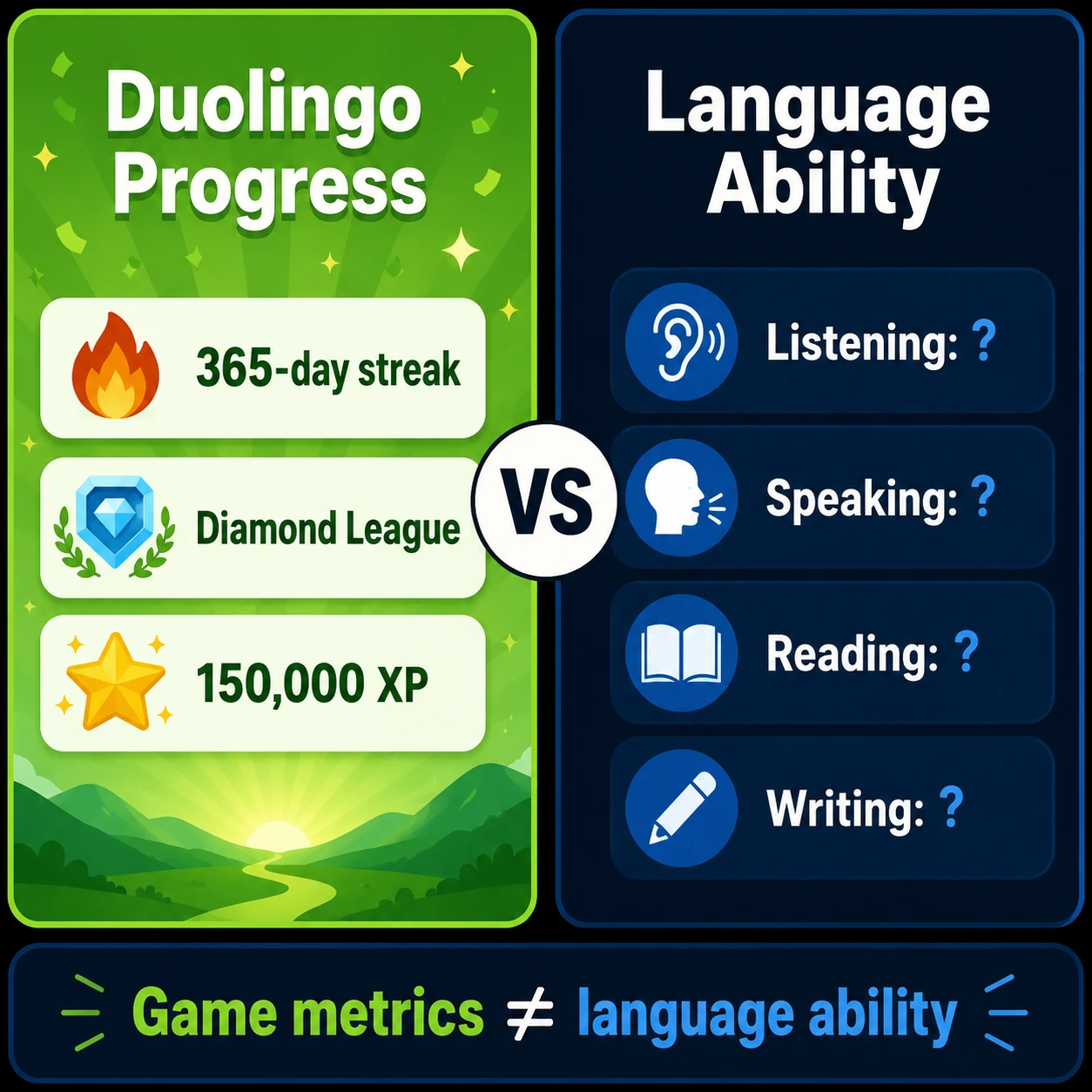
A streak measures consistency, not proficiency.
Two People Can Have the Same Streak
Imagine two people.
Both have a 365-day Duolingo streak.
Learner A
- Does around five minutes of Duolingo every day
- That’s roughly 30 hours of language exposure in a year
Learner B
- Also uses Duolingo
- But during that year they started watching beginner videos
- Then podcasts
- Then YouTube
- They played a game in the language
- They read something
- They occasionally talked to a tutor or language partner
- They might have accumulated hundreds of hours of exposure
- The Duolingo profile shows the same streak
Their actual language abilities could be completely different. That’s why I wouldn’t judge progress by XP, streaks or leagues
Use those things for motivation - Just don’t confuse them with the actual objective

Where Duolingo Starts Falling Short
The beginner stage is where I think Duolingo makes the most sense. The further you progress, the more obvious its limitations become.
One big problem is predictability.
- Real conversations are messy
- People mumble
- They change direction halfway through a sentence
- They use slang
- They speak faster than expected
They say something you have never heard before and expect an immediate response. An app exercise can’t fully recreate that.
Listening exercises also tend to be much cleaner than actual speech. And speaking exercises cannot recreate the pressure of someone looking at you and waiting for an answer.
This creates another trap: recognition feels like knowledge.
Seeing four possible answers and recognizing the correct one is much easier than producing the same sentence yourself during a conversation.
You can become very good at solving Duolingo exercises.
That doesn’t automatically mean you’ve become equally good at using the language.
So When Should You Move Beyond Duolingo?
I don’t think there needs to be some dramatic moment where you announce:
“I HAVE REACHED A2. DELETE THE OWL.”
If you enjoy Duolingo, keep using it.
Just gradually make it a smaller percentage of your language learning.
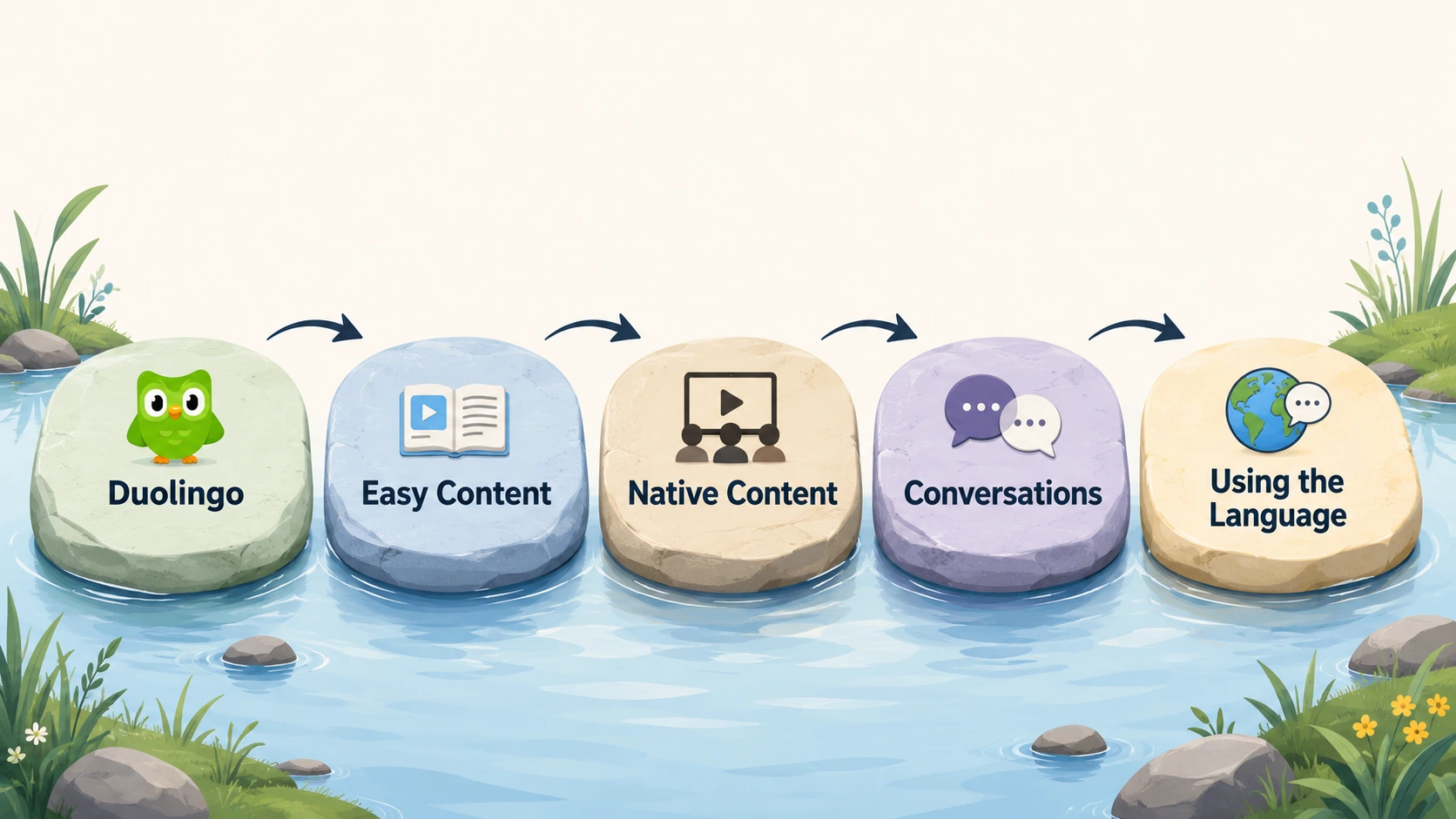
Something like this:
Duolingo
↓
Beginner videos / comprehensible input
↓
Podcasts / YouTube / games / TV
↓
Reading
↓
Conversations / tutors / language exchange
↓
Using the language naturally
You don’t have to follow that exact order either.
The important part is expansion.
Eventually, Stop Studying Everything
Something changed in my own language learning over time.
I still study languages.
But increasingly, I try to do things in them instead.
If I’m playing a game anyway, I can sometimes play it in Russian.
If I’m watching YouTube, some of it can be Spanish.
Podcasts can fill time where I would otherwise listen to nothing.
Books become reading practice.
Travel becomes speaking practice.
Conversations stop feeling like exercises and start becoming… conversations.
This is the stage I want to reach with every language.
The goal slowly changes from:
learning the language
to:
doing things in the language.
That’s also what makes languages sustainable for me.
If maintaining Spanish required sitting at a desk doing grammar exercises forever, I probably wouldn’t maintain it very well.
If Spanish is attached to games, videos, conversations and things I already enjoy, it becomes part of normal life.
Duolingo can help you start building the bridge.
Eventually, however, you need to cross it.
How I Would Use Duolingo Today
If I started another language tomorrow, I would happily use Duolingo again.
I just wouldn’t make it my entire strategy.
During the first few weeks, I would probably use it to become familiar with basic vocabulary and sentence structures.
At the same time, I would start listening to extremely easy content.
Then gradually:
- more comprehensible input
- beginner YouTube
- podcasts
- eventually games or TV
- reading
- and conversations when I have enough basic language to work with
Duolingo could stay.
Maybe ten minutes here and there.
Maybe on days when I don’t feel like doing anything else.
There is nothing wrong with that.
What I wouldn’t do is spend two years protecting a streak while waiting for the app to magically transform into real-world fluency.
So, Is Duolingo Worth Using?
Yes.
Especially if you’re a complete beginner.
It removes the confusion of starting, gives you some structure and can help establish a daily habit.
It can also be a cheap way to discover whether you actually enjoy learning a language before buying textbooks, courses or tutoring.
But eventually, you need more.
- You need native speech that isn’t perfectly clear
- You need sentences where nobody gives you four possible answers
- You need books you don’t understand completely
- You need conversations where you have three seconds to respond
- You need the actual language
So I don’t understand the hatred Duolingo sometimes gets.
But I also wouldn’t build my entire language-learning system around it.
Duolingo is a good place to start. It just shouldn’t be the place where your language-learning journey ends.
FAQ
Can you become fluent using only Duolingo?
I wouldn’t expect to. Duolingo can teach useful vocabulary and structures, but real language ability eventually requires much more listening, reading and communication.
Is Duolingo useless?
Definitely not. I think it is particularly useful for beginners because it makes starting extremely easy.
How long should you use Duolingo?
There isn’t a specific point where you need to quit. Instead, gradually introduce other activities until Duolingo becomes only one part of your learning.
Is a long Duolingo streak impressive?
It shows consistency, which is valuable. It doesn’t necessarily tell you someone’s language level.
What should I use after Duolingo?
Start adding beginner-friendly comprehensible input, podcasts, YouTube, reading, games and eventually real conversations.
Would I use Duolingo again?
Yes. I would use it during the beginner stage of a new language, while gradually adding more exposure to real-world language.