Language Learning - Stop Studying Languages and Start Living in Them
The biggest change in my language learning happened when I stopped treating languages as something I only studied and started using them for things I already enjoyed.
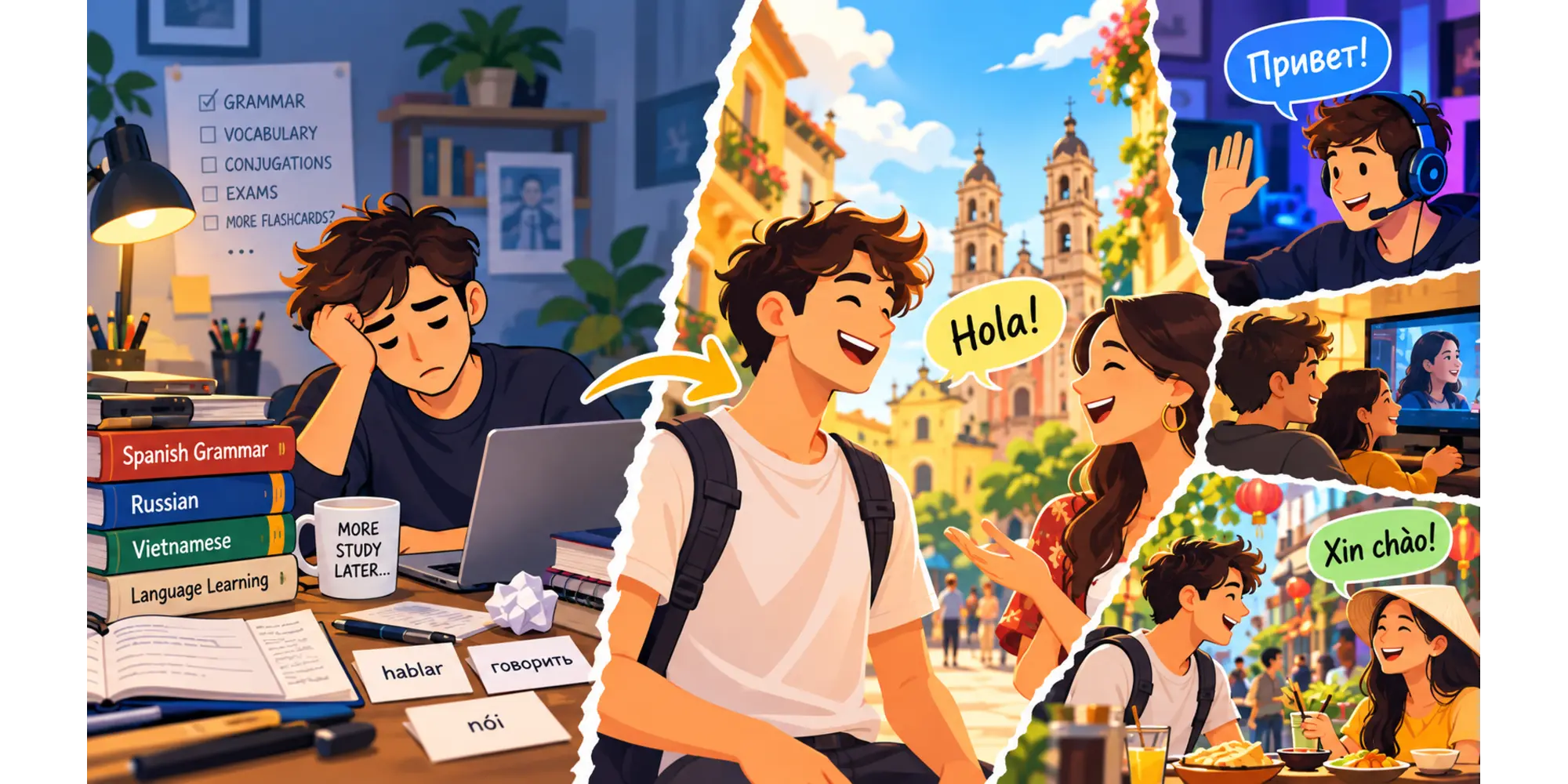
I Didn’t Actually Stop Studying
The title is slightly dramatic.
I still study languages.
I use flashcards. I have lessons with tutors. I look up grammar. I deliberately practise vocabulary. Sometimes I sit down and do something that very clearly feels like studying.
But over time, something changed.
Language learning stopped being limited to:
I have one hour. Now I will study Russian.
Instead, I started asking:
What am I already going to do today, and can I do some of it in Russian?
Or Spanish.
Or Vietnamese.
That sounds like a small difference, but for me it changed almost everything.
I didn’t necessarily need to find more free time.
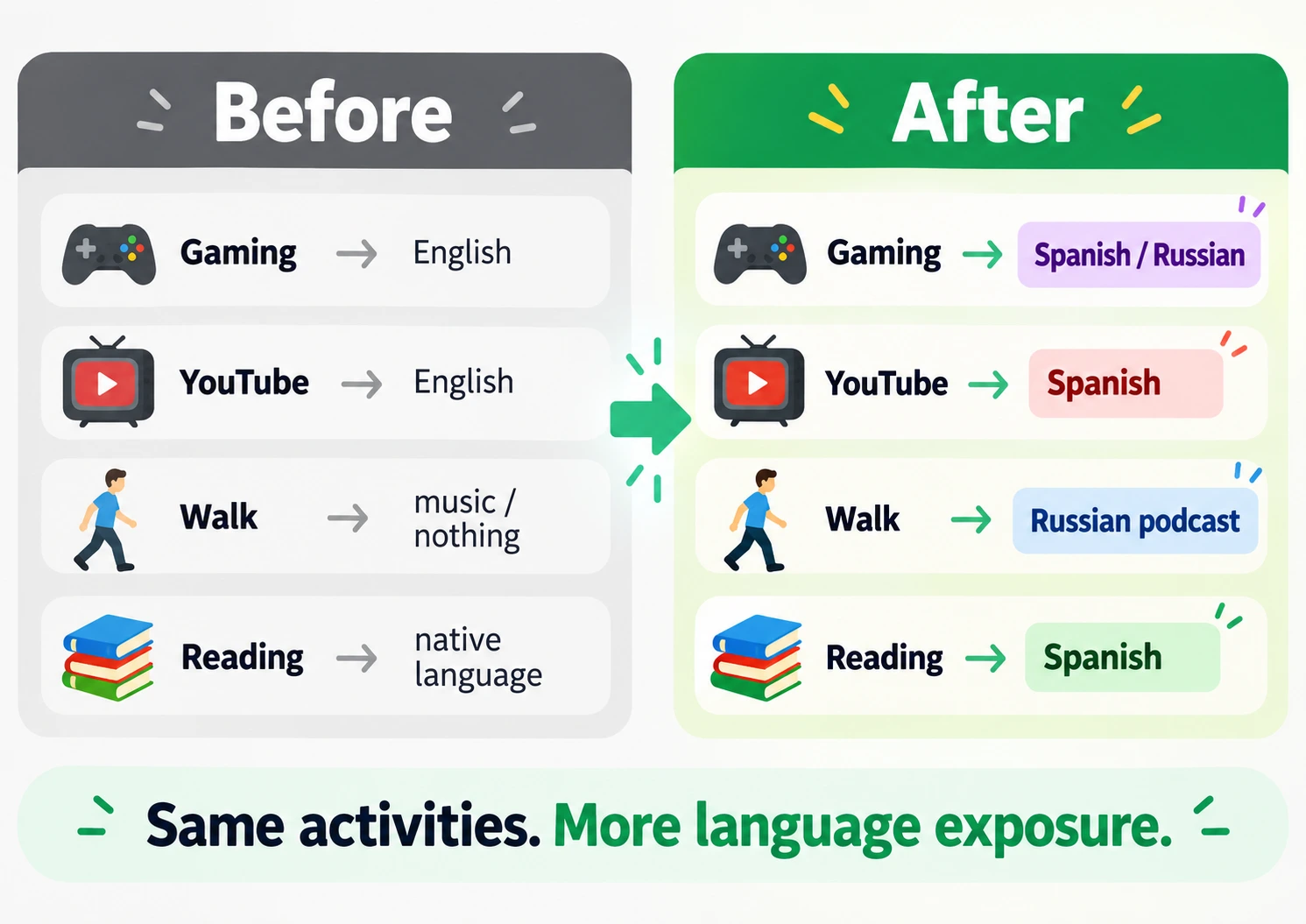
A lot of the time, I simply changed the language of something I was already going to do.
The goal slowly shifted from:
learning the language
to:
doing things in the language.
And that’s the stage I eventually want to reach with every language I learn.
Languages Used to Be a Separate Activity
When you start learning a language, separating it from the rest of your life makes sense.
You need the basics.
You don’t know enough vocabulary.
You don’t understand normal speech.
Everything feels difficult.
So you open a textbook, an app or a grammar lesson and deliberately study.
There is nothing wrong with that.
The problem is that I don’t want language learning to remain a separate task forever.
If maintaining Spanish for the rest of my life required me to sit at a desk every evening and complete Spanish exercises, I probably wouldn’t maintain it very well.
I already have enough things in life that I have to do.
I don’t want languages to become another item on the list.
So gradually, I started attaching them to things that were already there.
- Games
- YouTube
- TV shows
- Podcasts
- Books
- Music
- Conversations
- The internet
Things I was going to do anyway.
I didn’t always add language learning to my day. Sometimes I just changed the language of my day.
Games Were Probably the First Big Example
Gaming has been part of my life for a long time.
Looking back, English was probably the first language where this happened naturally.
I wasn’t sitting there thinking:
“Excellent. I will now acquire English through contextual exposure.”
- I wanted to understand games
- I wanted to understand people online
- I wanted to know what quests, items and dialogue meant
The language was attached to something I cared about.
Years later, I started doing the same thing deliberately with other languages.
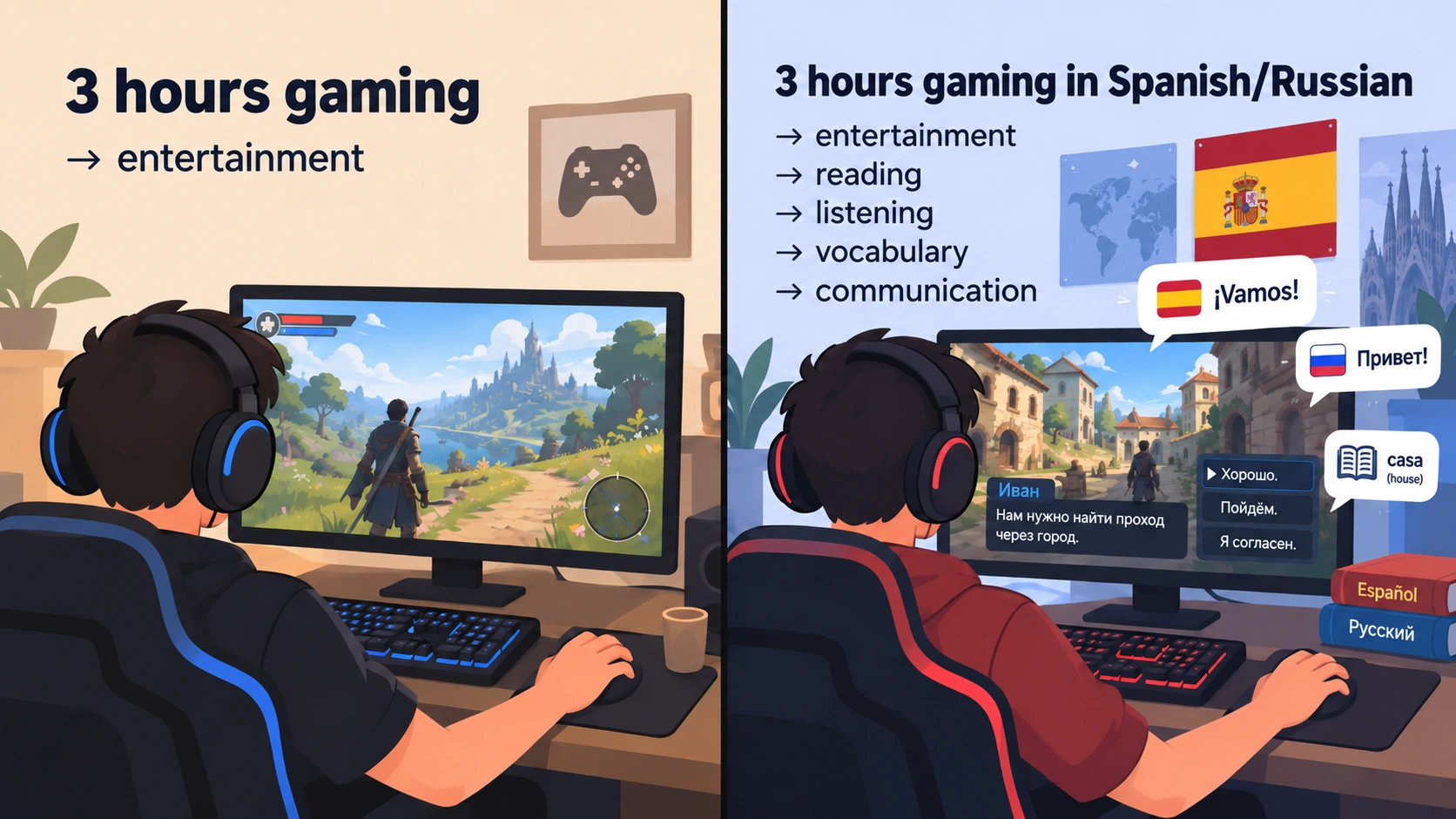
World of Warcraft became one of my biggest sources of Spanish exposure.
The game itself was in Spanish. I played with Spanish-speaking people. I used Discord. I heard the language while doing something that I genuinely wanted to do.
The important part is that I would probably have been playing WoW anyway.
I wasn’t creating a new activity called Spanish practice.
I was taking an activity I already enjoyed and switching it into Spanish.
The same thing started happening with Russian.
Games like Gothic became Russian input.
And now whenever I consider switching another game into Russian, I have the same internal argument:
Do I want maximum comfort, or do I want several more hours of Russian exposure?
Sometimes comfort wins.
And that’s fine.
I don’t think you need to destroy every hobby in the name of productivity.
But when a game works well in another language, the same evening of gaming can suddenly also become several hours of language exposure.
Entertainment Stopped Feeling Like “Practice”
The same happened with TV and YouTube.
Early on, watching something in another language feels like an exercise.
- You’re concentrating
- You’re trying to catch words
- You’re wondering whether you should pause
- Maybe you’re reading subtitles
- Your brain is clearly working
But eventually there is a weird transition.
You stop thinking:
“I’m practising Spanish.”
You’re just watching a show.
It happens to be in Spanish.
I’ve watched series in Spanish that I already knew well, which made the transition much easier. If you already understand the characters and story, you don’t need to decode every sentence to know what’s happening.
The language can take more of your attention because the plot requires less of it.
Russian gradually entered the same space through shows, YouTube and other content.
Vietnamese is still much harder for me, so the content has to be easier.
What feels like entertainment in Spanish can still feel like genuine study in Vietnamese.
And that’s normal.
You can’t force yourself to “live in a language” before you understand enough of it.
Long Walks Became Listening Practice
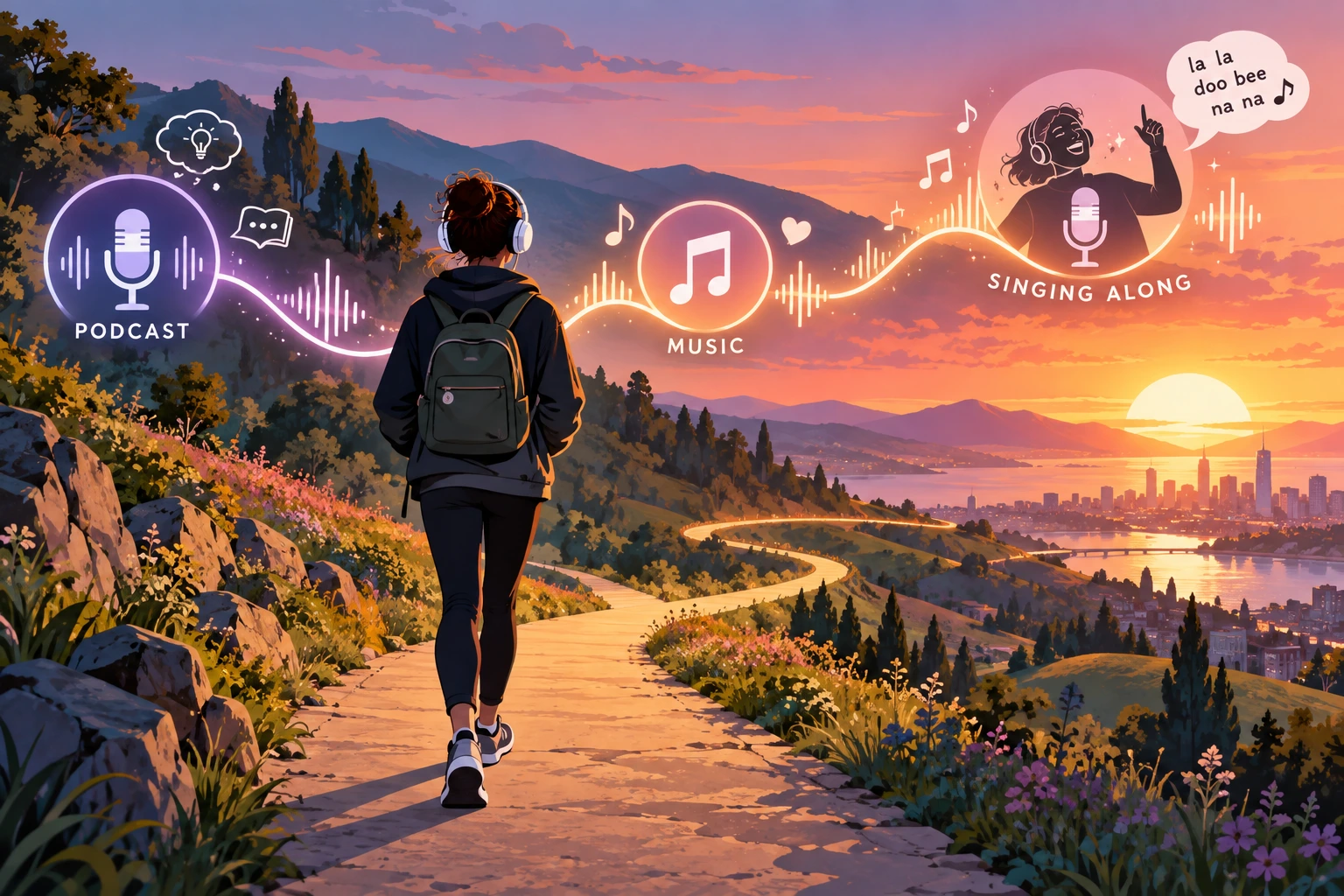
This is probably one of the easiest ways I’ve added more language exposure without actually sacrificing anything.
I like going for longer walks.
The walk takes the same amount of time regardless of what is playing in my headphones.
So instead of always listening to English or nothing at all, I can put on a Russian podcast.
Now the same walk is also an hour of Russian.
Again, I didn’t really add another hour of studying.
I replaced the audio.
That’s a pattern I use quite a lot.
A commute is still a commute.
A walk is still a walk.
Some repetitive task still takes the same amount of time.
But the language in the background can change.
And if I don’t feel like listening to a podcast?
Then I listen to music.
That’s still contact with the language, just in a much easier form.
And sometimes it becomes surprisingly active.
You start recognizing words.
Then entire lines.
Then you look up lyrics.
And eventually you’re walking around singing along to a Russian song and hopefully nobody nearby understands what you’re doing.
Not every minute of language exposure needs to be maximum-efficiency study.
Sometimes enjoying a song enough to sing the lyrics is exactly what keeps the language around.
Conversations Changed Everything Again
There is another level beyond consuming content.
Actually using the language with people.
This is where a language stops feeling like information you’re collecting.
You need it for something.
My Spanish became much more real when it wasn’t just something inside an app or Netflix.
It was something I could use with people in games and on Discord.
Suddenly I wasn’t forming sentences because an exercise told me to.
I had something I actually wanted to say.
That’s a very different feeling.
I still experience a huge gap between understanding a language and comfortably speaking it, especially in languages I’m still improving.
You can understand a conversation perfectly well and then suddenly your brain forgets every word you’ve ever learned when it’s your turn to speak.
Fun.
But even awkward conversations are different from exercises.
Nobody gives you four possible answers.
Nobody waits while you analyse the grammar.
The conversation just continues.
And slowly, you learn to continue with it.
Books Are Starting to Become Part of It Too
Reading is another area where I’ve been gradually trying to make the same transition.
A book in another language is obviously much harder than reading in your native language.
At first, every unknown word feels important.
You want to look everything up.
A page takes forever.
Then the book stops being a book and becomes a very inefficient dictionary exercise.
I’m trying to get better at letting some things go.
If I understand what’s happening, I don’t necessarily need to understand every adjective.
The long-term goal is the same as with games and shows.
I don’t want to forever practise reading Spanish.
I want to read a book that happens to be in Spanish.
Those two things look almost identical from the outside.
Mentally, they’re very different.
I Still Need Actual Study
None of this means I think deliberate study is useless.
Quite the opposite.
Living in a language becomes much easier when you have enough vocabulary and grammar to actually understand it.
I still use tutors.
I still create flashcards.
I still deliberately practise new vocabulary.
With Vietnamese especially, structured learning is still extremely important for me because I simply don’t understand enough yet to replace study with normal native content.
Russian is somewhere in the middle.
Spanish is much closer to the point where I can spend a lot of time simply using it.
Different languages need different things.
That’s why I don’t really believe in one universal routine like:
30 minutes Anki + 60 minutes comprehensible input + 15 minutes shadowing + 2.7 conversations per week.
Maybe that’s perfect for someone.
I’d probably survive four days.
What works better for me is having some deliberate learning and then trying to make the language leak into the rest of my life.
Don’t Turn Your Entire Life Into Homework
There is a danger here too.
Once you realise you can convert your hobbies into language exposure, it becomes tempting to optimise everything.
Game? Netflix? YouTube? Phone? Book?
Target language.
At some point, you’re allowed to relax.
If playing a complicated new game in Russian makes it 70% less enjoyable, maybe don’t.
If you’re exhausted and just want to watch something in English, watch it in English.
If you don’t have the mental energy for a Russian podcast during a walk, put on Russian music instead.
Or don’t.
The point isn’t:
Everything must become language learning.
The point is:
Things you already enjoy can sometimes do two jobs at once.
You can have fun and practise a language.
You can go for a walk and practise listening.
You can play a game and read thousands of sentences.
You can listen to music and learn lyrics without feeling like you’re doing homework.
That’s the part I find powerful.
The Best Activities Are the Ones You Would Do Anyway
This is probably the main lesson I’ve taken from all of this.
The most sustainable language activities for me are often the ones that don’t exist purely because I’m learning a language.
- I was going to play the game anyway
- I was going to watch YouTube anyway
- I was going to go for that walk anyway
- I was going to listen to music
- I was going to read
- I was going to talk to people
The only thing that changed was the language.
And once that happens, the number of hours you can spend with a language changes dramatically.
Studying for three hours requires motivation.
Playing a game you love for three hours usually doesn’t.
Going for a long walk while listening to an interesting podcast doesn’t feel like sitting through a one-hour listening exercise.
Singing along to a song definitely doesn’t feel like studying vocabulary.
Yet all of it keeps the language present.
The easiest language practice to maintain is often the practice hidden inside something you already wanted to do.
From Learning a Language to Having a Life in It
I think this is ultimately what I’m trying to build with every language.
Not just a collection of vocabulary and grammar rules.
A small part of my life that exists in that language.
Spanish already has games, videos, conversations and entertainment attached to it.
Russian is gradually getting there through games, podcasts, shows, music and conversations.
Vietnamese is much earlier in the process, so for now there is still more deliberate study.
Hopefully that changes with time too.
And once enough parts of your life exist in a language, maintaining it becomes much easier.
You don’t constantly need to remind yourself:
“I need to practise Spanish.”
You want to watch something.
You go for a walk.
Someone sends you a message.
You join a conversation.
You start a game.
A song comes on and you start singing along.
And the language is simply there.
For me, that’s a much more interesting goal than finishing another course.
The best stage of language learning is when you occasionally forget that you’re learning at all.